To the N.A of the present village of Bardates, there was the ancient city of Trachis, the founder of which is considered to be Heracles, who had settled there with his wife Deianeira. According to mythology, Deianeira, wanting to prevent Heracles from new infidelities, sent her husband the official tunic, which he had asked her to make a sacrifice to the gods. The tunic, however, was drenched in the blood of the Centaur Nessus, who, dying from a poisoned arrow of Hercules, advised Deianeira to give it to her husband to rekindle their love.
The unsuspecting Heracles put on the tunic brought to him by Licha’s servant and immediately he was shocked by horrible pains. He uprooted centuries-old trees and rocks from Oitis with his hands and begged Zeus to rescue him. In vain, though. He grabbed Lichas in anger and hurled him into the Euboean Gulf, where the Lichadonisia grew from his limbs. Diianeira, seeing what she had unwittingly caused, committed suicide.
Oitis, shocked by the martyrdom of the hero, split in two and from the fissure the river Dyras, today’s Gorgopotamos, sprang up to run to the aid of Herakles. The Oracle of Delphi then sent an oracle: “Take him to the top of Oiti, gather wood for a big fire and let Heracles climb the pile. The gods will take care of the rest.” However, no one was setting fire to the wood. Then Philoctetes took pity on him and set fire to him. Out of gratitude, Herakles gave him his bow and arrows, with which he later conquered Troy. When the fire was lit, a cloud grabbed Hercules and carried him up to Olympus. The place where they lit the fire is still called the Fire of Herakles.
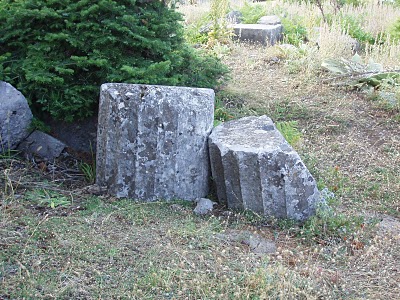
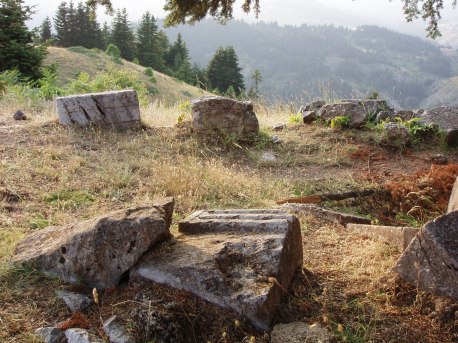
Column vertebrae, parts of the trigo and triglyphs are preserved, which belong to a prostyle Doric temple of the 3rd century BC. with vestibule and nave in front. To the south of the church there is the altar, which was used continuously from the archaic era until the Roman period, when the original outline was expanded and demarcated with stone bricks. In the years 1919 – 20, excavation research was carried out by N. Papadakis. The visible part of the Temple was cleaned and the Pyra was excavated. From 1988, the excavation at the site of Pyra was repeated with further investigation of the already disturbed embankments.